How the Foxwoods Theatre Was Rebuilt for Spider-Man Turn Off the Dark
Exhibit R: The Building as a Load-Bearing Character
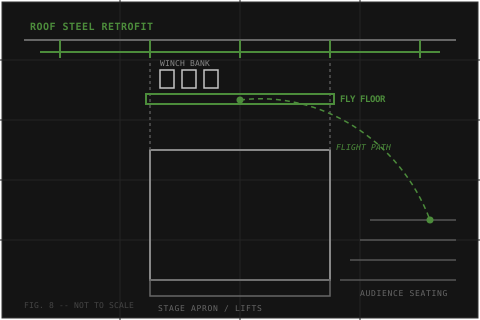
Most Broadway productions move into a theatre. Spider-Man: Turn Off the Dark moved into the Foxwoods Theatre and then had the building itself altered to fit the show. The production needed performers to fly not just above the stage, in the manner of a standard Broadway flying effect, but out over rows of paying customers, at speed, night after night. No theatre on 42nd Street had been built to carry that kind of load over an occupied audience floor, so before a single preview could happen, the Foxwoods had to be engineered around it.
The most significant structural work happened well out of sight of the audience. Geiger Engineers, the structural firm brought in to design the flying-effects system, built a complete computer analysis model of the theatre's Front of House roof structure to work out how the rigging's loads would actually travel through the building once performers were airborne. The conclusion was that the existing roof could not simply carry a flying rig as an add-on: additional steel had to be designed and installed as a retrofit, specifically because so many of the flight sequences were routed over the seating rather than confined to the space above the stage. A reinforced fly floor and a set of dedicated structural connection points were built into the theatre to anchor the system at the load-bearing points the rigging actually needed.
Exhibit S: The Machinery Behind the Flying
The flying hardware itself came from Fisher Technical Services Inc., a company led by Scott Fisher that has since been folded into the entertainment-technology firm now known as TAIT. Rather than a single winch pulling a single wire, the system on Spider-Man extended a traditional four-point flying rig into a much larger bank of winches, drawn from several different Fisher Technical machine models, with a combined output well over a thousand horsepower. That scale was what let aerial performers travel around large sections of the auditorium rather than swinging on a fixed arc above the stage, a distinction that separated this production's flying from the more contained effects Broadway had used before it.
Aerial designer Scott Rogers, who had worked as a stuntman and stunt coordinator on more than eighty films including two of the Spider-Man movies, and aerial rigging designer Jaque Paquin, whose background included acrobatic rigging work recognized with a 2005 industry award, were responsible for how those flights were actually choreographed and rigged for a live eight-times-a-week schedule. Because so much of the hardware sat directly above ticket holders, the engineering review did not stop at the design stage. Geiger Engineers also liaised with the New York State Department of Labor and submitted documentation supporting the state's approval of a labor variance for the production, a regulatory step made more pressing after stunt performer Christopher Tierney's December 2010 fall prompted a formal safety review of the show's rigging, discussed in more detail elsewhere on this site.
Exhibit T: After the Show Closed, the Building Had to Change Back
Spider-Man: Turn Off the Dark closed on January 4, 2014. The lease terms behind the production reportedly required the theatre to be returned to its pre-show condition once the run ended, which meant the stage-lift structure installed in place of the original concrete stage apron could not simply stay in place for the next tenant. Geiger Engineers returned later in 2014 to design a replacement: a modular stage apron built from composite steel-deck-and-concrete panels, engineered so that a future production could reconfigure the stage without requiring another full demolition, a more permanent fix than the temporary lift work the flying show had needed.
The venue's name changed again not long after. Built in 1998 as the Ford Center for the Performing Arts, the theatre had already been renamed the Hilton Theatre in 2005 and then the Foxwoods Theatre in 2010, timed to Spider-Man's arrival, under a naming-rights deal with the Foxwoods Resort Casino. In March 2014, a few months after the production closed, it reverted to Lyric Theatre, the name it had briefly carried decades earlier. A revival of On the Town became the first production to open under the restored name that October. Since 2018, the Lyric Theatre has been the long-running home of Harry Potter and the Cursed Child, which continues to occupy the same auditorium the flying rig was once engineered into.
None of that later history erases the specific technical fact at the center of this page: for a little over three years, one Broadway building was structurally rearranged, roof steel and all, around the needs of a single production's flying effects, then structurally rearranged again once that production left. The Foxwoods Theatre's brief existence under that name is, in a very literal sense, a building shaped entirely by one show. For how that same production's extended technical rehearsals compare to other Broadway shows known for unusually long preview periods, see the site's look at Broadway's longest preview runs, compared.
INTERROGATION: THE BUILDING FAQ
What structural changes did the Foxwoods Theatre need for the flying sequences?
The theatre's Front of House roof structure was retrofitted with additional steel to carry the loads of a flying-effects system, since many of the aerial sequences passed directly over the audience rather than just the stage. A reinforced fly floor and a run of dedicated mounting points were added inside the building to anchor the rigging, and the original concrete stage apron was demolished and replaced with stage lifts to support the production's staging needs.
Who engineered the rigging and flying system?
Geiger Engineers designed the flying-effects structural system, building a full computer model of the roof structure to calculate how the rigging loads would move through the building. Fisher Technical Services Inc., led by Scott Fisher, supplied and engineered the winch-driven flying hardware itself; the company now operates under the name TAIT. Scott Rogers served as aerial designer and Jaque Paquin as aerial rigging designer, both bringing backgrounds in stunt and acrobatic rigging work to the production.
What happened to the theatre's structural changes after Spider-Man closed?
The production was contractually required to return the theatre to its pre-show condition once its run ended. Geiger Engineers returned in 2014 to replace the temporary stage-lift structure with a new modular stage apron built from composite steel-deck-and-concrete panels, designed so the venue would not need a full demolition again for future productions.
What is the venue called today, and what show is playing there?
The building reverted to its original name, the Lyric Theatre, in March 2014, a few months after Spider-Man closed. A revival of On the Town was the first production to play there under that name, and Harry Potter and the Cursed Child has been the resident production at the Lyric Theatre since 2018.